The school running itself between your office and the parent.
Features
What a school gets
The messages write themselves, because the register, the fees and the assessment records all live in one place.
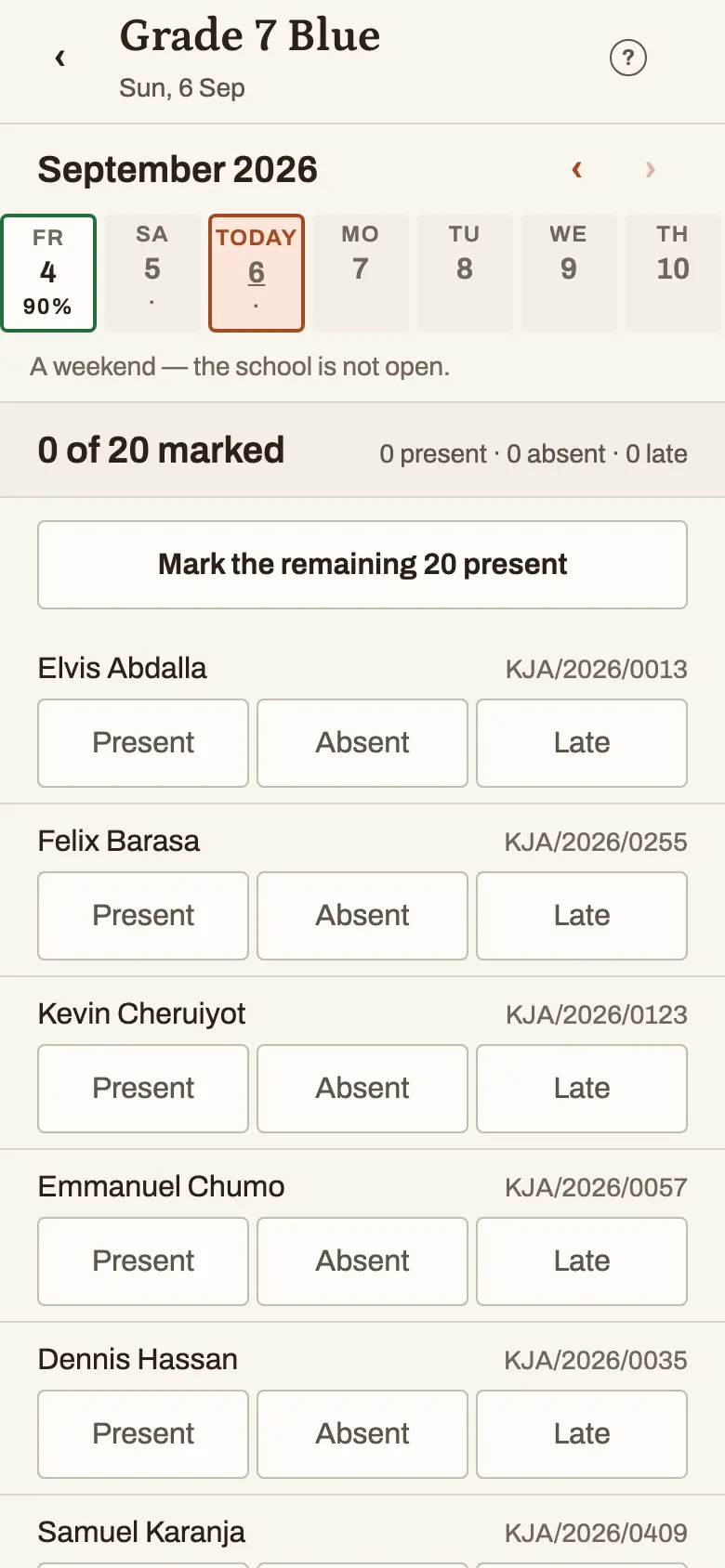
The daily register
Marked on a phone in under a minute, signal or no signal.
Absence messages
Marked absent at 8am; the mother knows at 8:05. Nobody typed anything.
Fees and statements
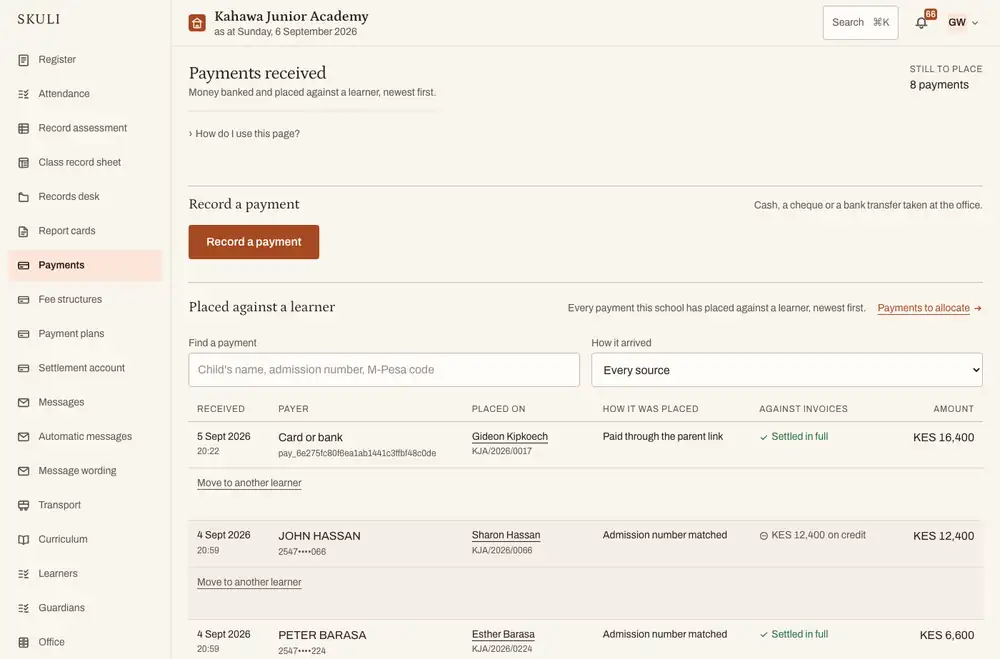
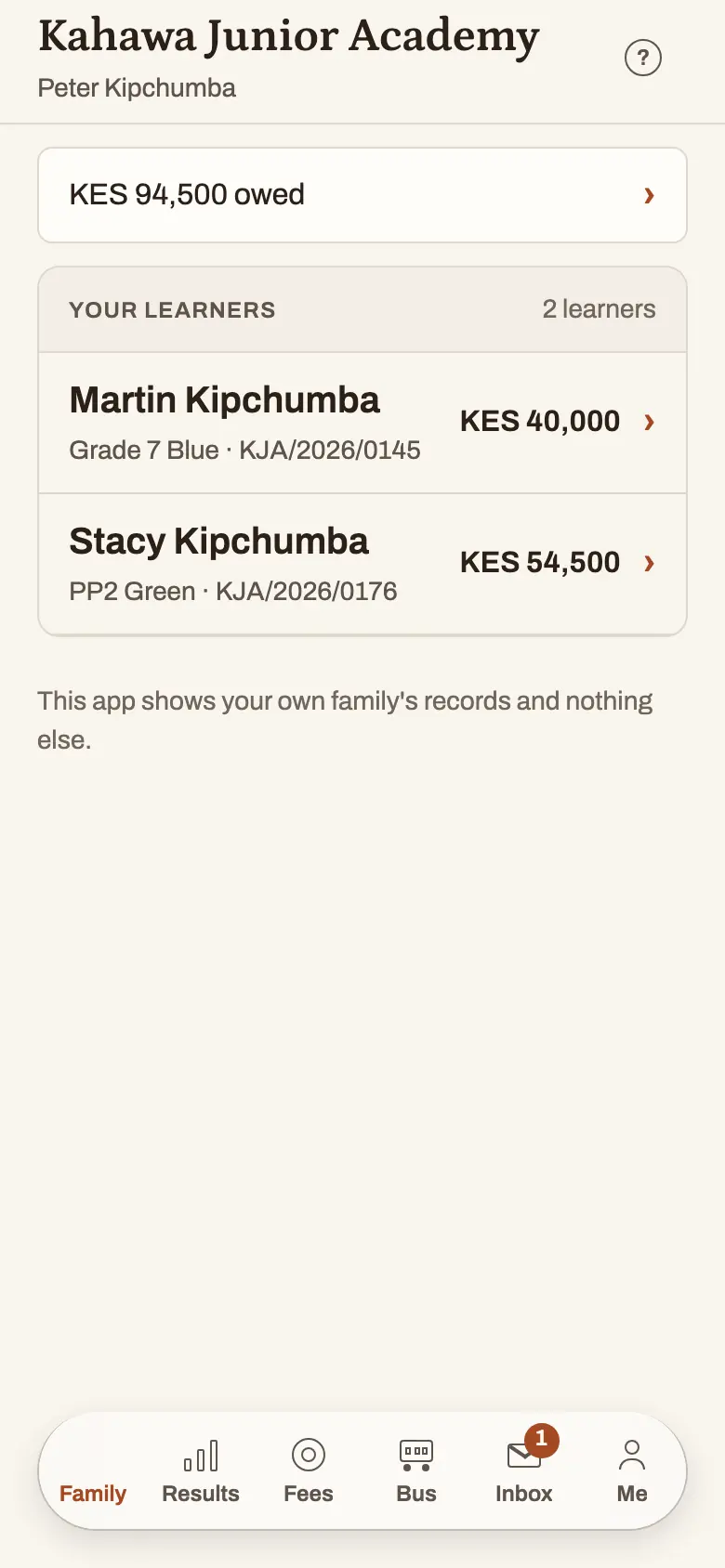
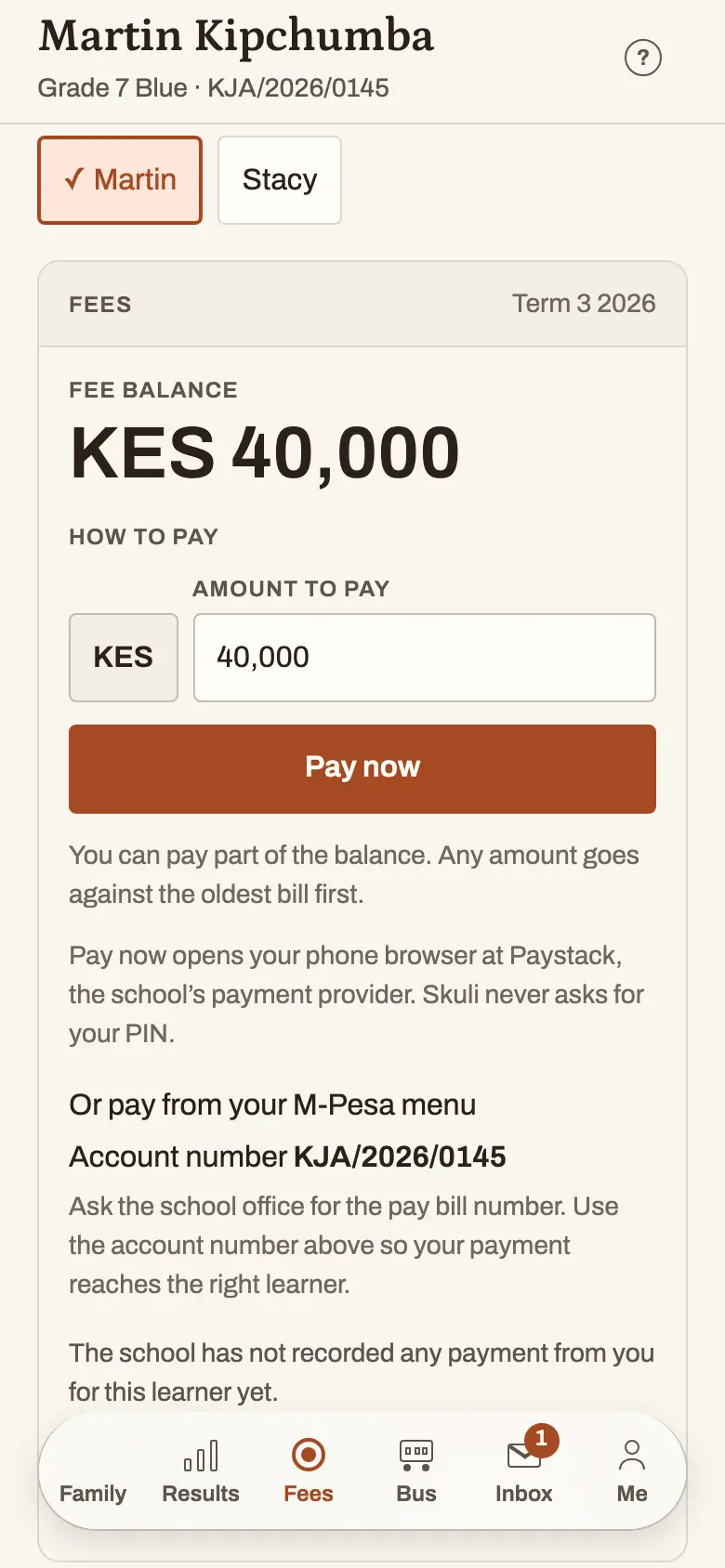
Invoices, payment plans, and a statement the parent opens from a message.
M-Pesa matching
Matched to a learner by admission number; the rest queue for a person to place.
Assessment and reports
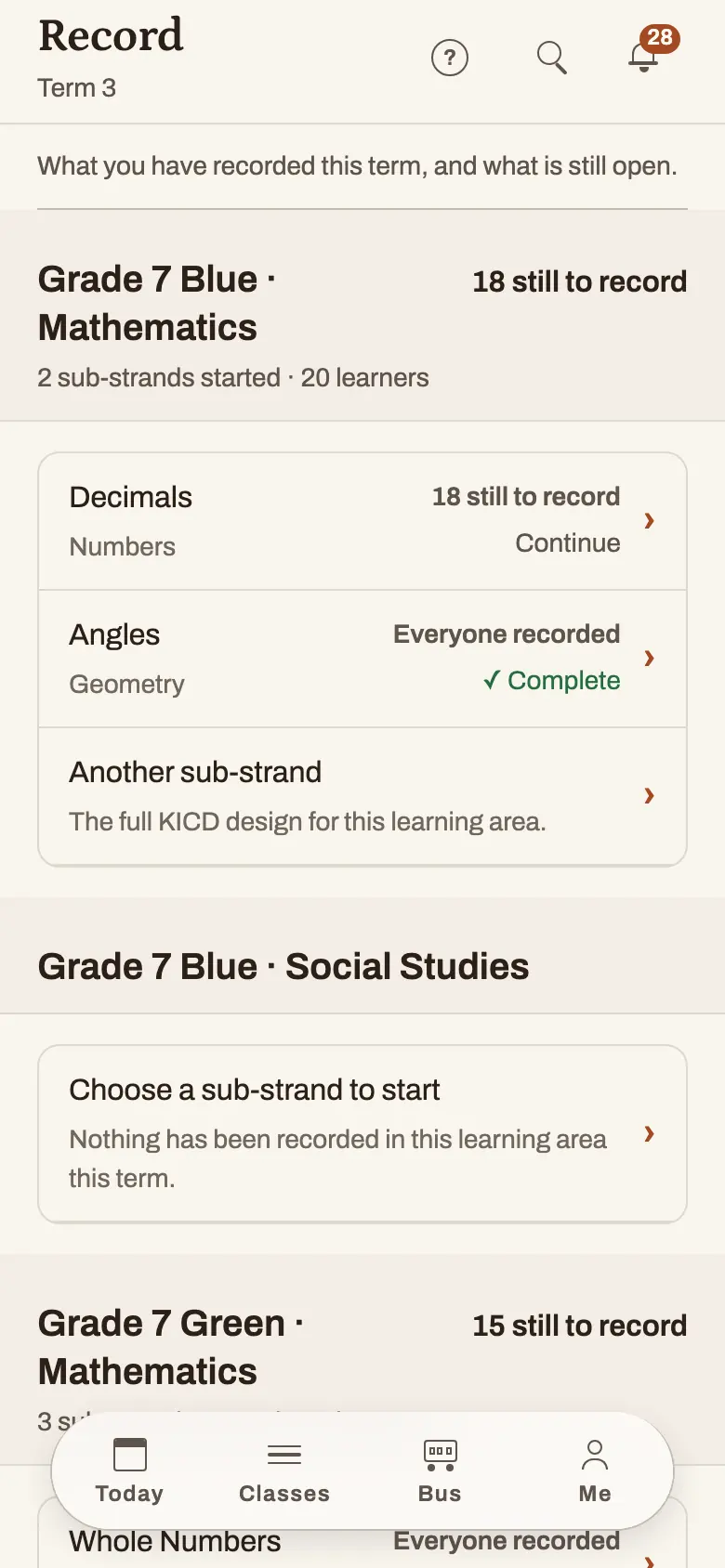
Records against strands and sub-strands, and the report card they produce.
KNEC SBA assist
A completion board, and one sheet in the order the portal asks for.
The school bus
A matron taps each child on and off; the parent hears both ends.
An app, and a link for everyone else
One app for parents and staff — and every message carries a link for anyone without it.
The same app, on a teacher's phone and on a parent's
How it works
A Tuesday, once the school is running on Skuli
- 08:05Class teachers mark the register on their phones.60 seconds each
- 08:0623 absence messages reach guardians.Automatic
- 09:00The arrears sweep fires. 180 parents get their agreed instalment reminder.Automatic
- 11:0014 M-Pesa payments land, match to learners, and each parent gets a receipt.Automatic
- 15:30The bursar clears 3 payments that came in with the wrong reference.10 minutes
- 16:00You open your phone: collected today, arrears down 4% on last week.15 seconds
Messages sent ≈220 · Messages anyone typed 0 · Staff time <20 min — a worked day at a 450-learner school, not a measurement taken at one.
The 09:00 reminder is not nagging. It is the agreed payment plan, with a message before each instalment: “Your agreed instalment of KES 5,000 is due Friday” collects very differently from “your balance is KES 5,000.”
Pricing
What your school pays
One more child is one more register mark, one more message and one more invoice. A timetable is the same work at 900 learners as at 200.
Essential
The child’s record, and it reaches the parent.
KES 75
per learner, per term
- The daily register, and the absence message it sends when it closes
- Assessment records, and the report card they print
A 450-learner schoolKES 33,750 a term
Standard
Everything in Essential, and the money.
KES 140
per learner, per term
- Fee structures, invoices and statements
- M-Pesa payments matched to a learner on the admission number
- Payment plans, and the reminder before each instalment
A 450-learner schoolKES 63,000 a term
Under 150 learners you are billed as 150; above 900 we work it out together.
Add to either plan, a flat price per term
- The timetableKES 6,000
A week generated in a second, with the periods that would not fit named first — then every teacher’s own day on their phone, and the app tells them before each lesson and when a colleague asks them to cover.
- The school busKES 8,000
Each child tapped on and off, and the family told at both ends of the journey.
- The staff registerKES 5,000
Present, late, absent or on approved leave — and never a clock-in time.
In every plan
- Learner and guardian records
- Messages to a parent with the app — free, unlimited, on every plan
- An SMS allowance on top, and you only pay past it
- The app, for parents and for staff
- And a link for anyone without one — no app, no password
- Your data, exportable at any time
Terms
- Billed termly, in the weeks your own fees land — nine billed months a year, not twelve.
- If an invoice goes unpaid, messaging pauses. Your records, your exports and your read access never do.
- Your school owns its data and can export all of it on 30 days’ notice.
What directors ask
The questions, in their own words
“Someone quoted me thirty thousand.”
That’s a fair price for a records database. Ask them three questions. When a child is marked absent, who tells the mother? When a parent pays with the wrong account number, who finds it? Does it help your Grade 7 teachers with the KNEC portal? All three answers are no, because it is a database.
“We already have a system.”
Then you’ve done the hard part. Two questions: does it message parents on its own, and does it help with the KNEC portal? If it does both, honestly, stay where you are.
“This is too expensive right now.”
Then start narrow: Essential now, and add the fee ledger or the bus once you have seen it work.
“Where is our data? Is it safe?”
Yours, and hosted in Nairobi. Every look at a child’s record goes onto an append-only trail that the database itself refuses to let anyone edit. And every guardian gets a private channel rather than a group: a school WhatsApp group shows two hundred parents’ numbers to each other beside photographs of other people’s children, which is what the Data Protection Act is about. Consent is recorded with a timestamp, and photo permissions stay off until a parent grants them.
“Our parents don’t have smartphones.”
Then they never need the app. Every message is also an SMS carrying a link that opens in any browser, and on a feature phone the SMS alone carries the balance and the absence.
Contact
Ten minutes at your school, and I come to you
I’m a software developer, and I live here in Kahawa West.
- This weekAn hour with your bursar. No slides.
- Two days laterThis, back with your school’s real numbers in it.
- On signatureWe import your learner and guardian records and clean the phone numbers.
- Before go-liveTwo training sessions — one for the office, one for teachers.
- Term boundaryGo live, running alongside your current process for the first term.